Controlling Fan Coil Units (FCU) Based on Actual Occupancy
- Location
- Riyadh
- Period
- 2026
- Status
- In progress
- Role
- Designing the control strategy and supervising implementation and verification
Overview
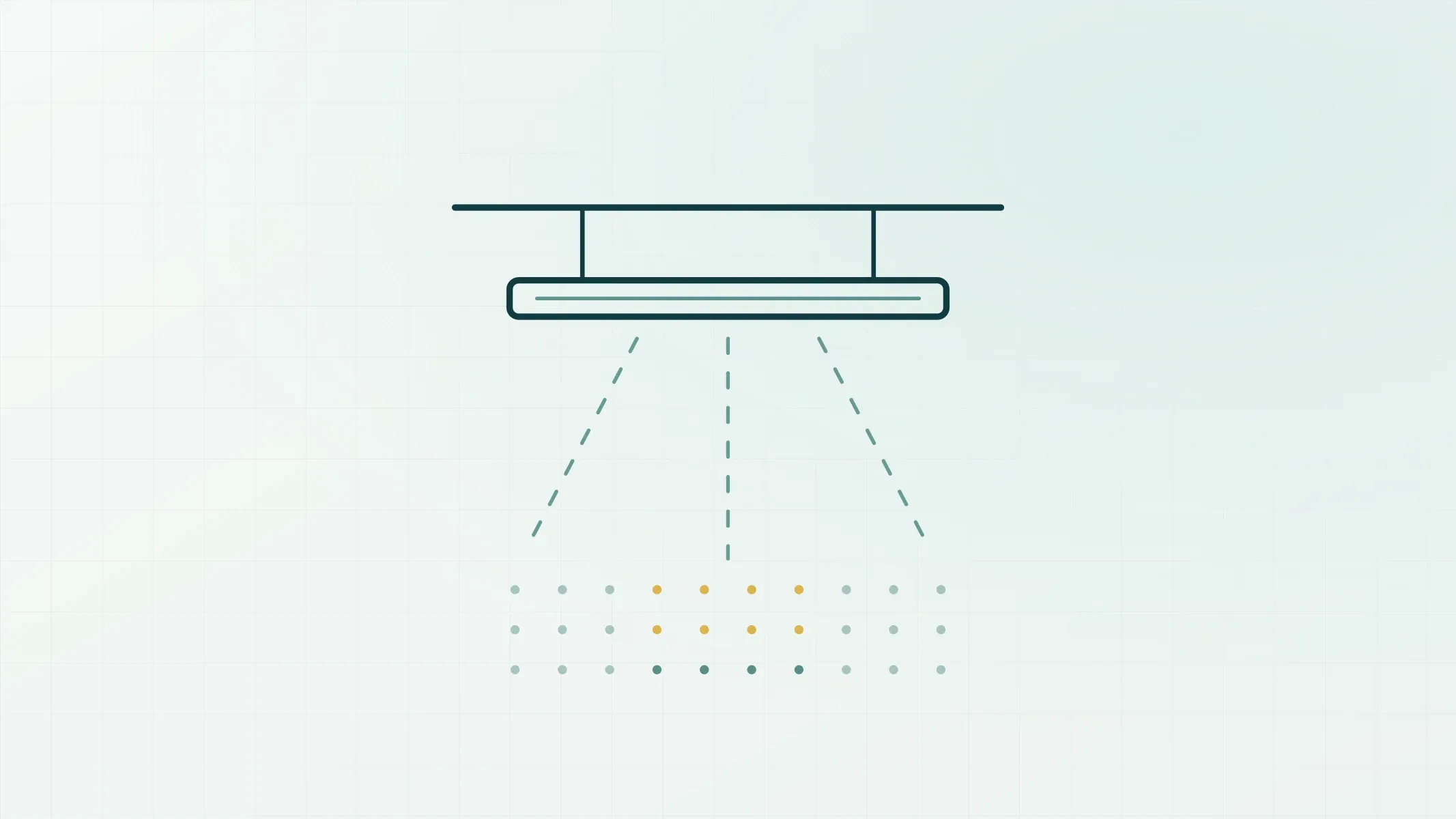
Designing an operating strategy based on the actual occupancy of fan coil units using PIR occupancy sensors, so that the system automatically controls operation according to actual presence.
Fan coil units typically operate according to fixed schedules or manual control, so they keep running in empty spaces. Actual occupancy in educational and residential facilities is intermittent by nature, which makes presence-based control far more effective than any fixed schedule.
This initiative belongs to smart buildings more than it belongs to energy efficiency: the result is savings in consumption, but the means is making the building respond to those within it.
Why occupancy, not schedule
A fixed schedule assumes a usage pattern. An occupancy sensor reads actual usage. In spaces with intermittent occupancy, the gap between assumption and reality is itself the amount of waste.
Responsibility
My role
- Designing the operating strategy and control logic in full.
- Defining delay and response periods to prevent oscillating operation.
- Providing engineering supervision of installation and calibration.
- Verifying that reduced operation did not compromise indoor environmental quality.
Handling
Challenges & actions
Each challenge is linked directly to the action taken and its operational impact.
Challenge
Oscillating operation from transient movement near the sensor.
Action
Tuning on/off delay periods that prevent responding to momentary movement.
Impact
Stable operation without short cycles that stress the equipment.
Challenge
The possibility of thermal comfort being affected when units are switched off.
Action
Defining a minimum operating level and a conditioning period before expected occupancy.
Impact
Maintaining indoor environmental quality while reducing runtime hours.
Summary
Lessons learned
01
Occupancy-based control fails in practice if the delay periods are not precisely tuned — the logic matters more than the sensor.
02
Any efficiency measure that touches thermal comfort must have its effect on comfort measured before consumption.
On-site
Photo gallery
The occupancy sensor used in the control strategy.