Separating Residential Buildings from Government Buildings via a Smart Electricity Metering System
- Location
- Riyadh
- Period
- 2026
- Status
- In progress
- Role
- Leading execution, coordination with the electricity service provider, and engineering supervision
Overview
An electrical infrastructure project to restructure metering in Faculty Members Housing: a field inventory of feed points and load assessment, and the installation of 1,134 smart meters in coordination with Saudi Energy (SE), with verification that each meter matched its point before approval — giving each building an independent reading on which billing and conservation programs can be built.
The government buildings and residential units in the housing were fed under shared electricity accounts through an outdated metering infrastructure, so no single building's consumption could be identified or billed independently. The project's engineering objective: to separate the electrical consumption of the residential buildings from the government buildings by upgrading the metering system, giving each building an independent metering point and a clear reading on which billing and monitoring can be built.
The project’s objective is purely engineering: to separate residential-building consumption from government-building consumption by upgrading an outdated metering system, not to reduce consumption.
From shared accounts to independent metering
The feed was shared and the metering infrastructure was outdated, so a residential building’s consumption could not be distinguished from a government one’s. The project rebuilt the metering system at the housing level: more than a thousand independent metering points where there had been aggregated accounts and outdated meters — each building with an independent reading and a clear billing party.
Execution in an occupied environment
The residential units are occupied, and their electrical interconnection cannot tolerate long interruptions. Interconnection work was scheduled in short batches in coordination with residents and operations parties, with verification that each meter matched the correct feed point before approving each batch — in coordination with Saudi Energy (SE) to satisfy the separation, metering, and interconnection requirements.
Responsibility
My role
- Leading project execution from the field inventory through approval.
- Coordinating with Saudi Energy (SE) on separation and metering requirements.
- Reviewing the meter board design and the distribution of metering points.
- Engineering supervision of installation and interconnection.
- Verifying reading accuracy and matching each meter to the correct feed point.
Handling
Challenges & actions
Each challenge is linked directly to the action taken and its operational impact.
Challenge
Mixed feed between government buildings and residential units on shared points.
Action
A field inventory of every feed point and its reclassification before defining the meter scope.
Impact
An accurate basis for separation instead of relying on outdated drawings.
Challenge
Execution on occupied residential units that cannot tolerate long power interruptions.
Action
Scheduling interconnection work in short batches in coordination with residents and operations parties.
Impact
Completing installation without disruptive interruption to residents.
Challenge
The need to match each meter to the correct feed point before approval.
Action
Verifying each meter's readings and matching them in the field before closing each batch.
Impact
Preventing billing errors that are difficult to correct after approval.
Impact
Results
- Smart meter
- 1,134
Summary
Lessons learned
01
Separation accuracy starts from the field survey of feed points, not from outdated drawings.
02
Upgrading the metering infrastructure gives each building an independent reading on which billing and monitoring can be built.
03
Early coordination with the service provider shortens the interconnection and approval cycle more than any acceleration in execution.
On-site
Photo gallery
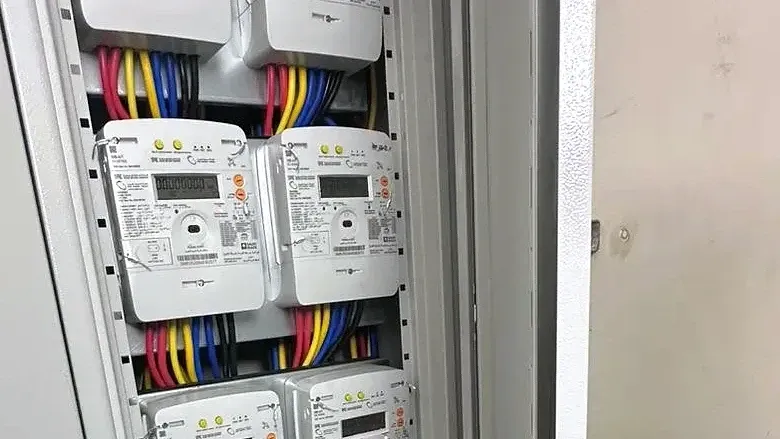
The meter board after installation and interconnection were completed. Distribution of meters inside the board with the feed routing.